
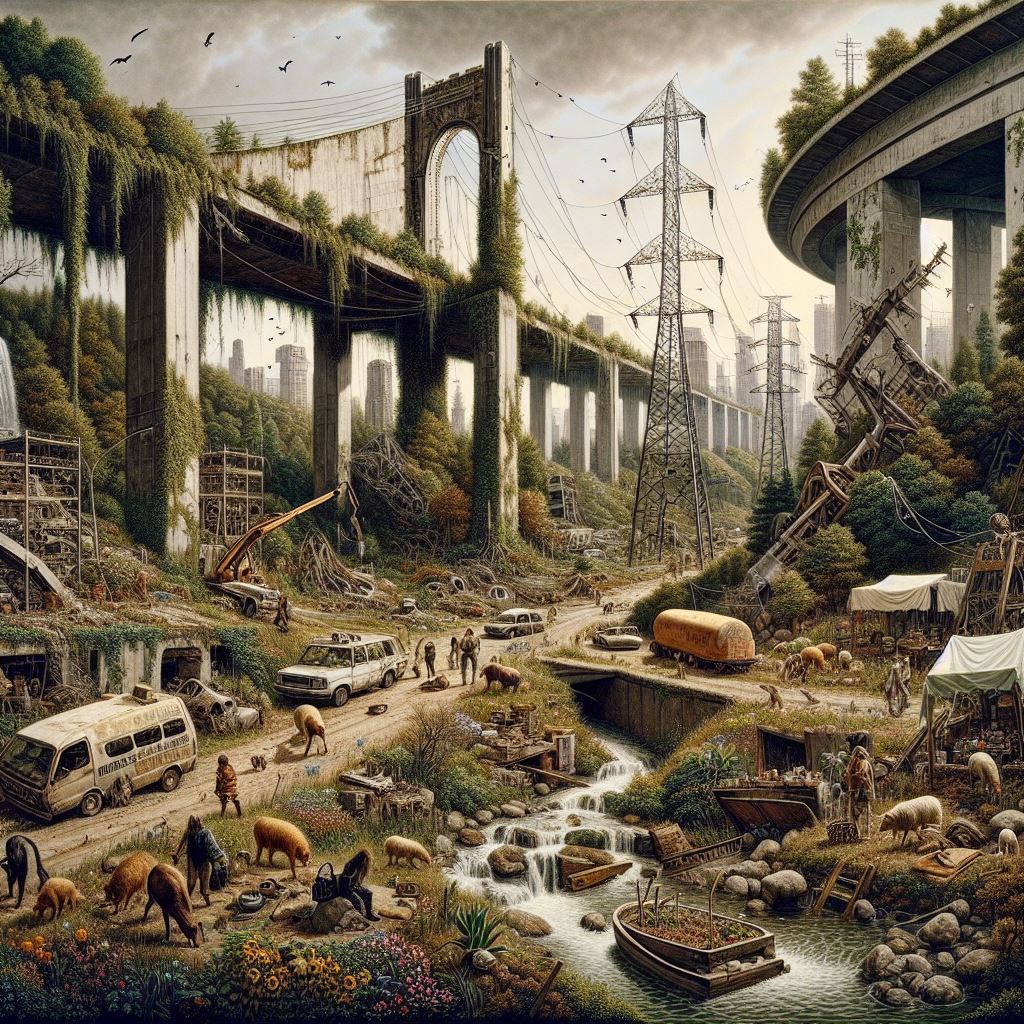
America is waging wars of expansion across two continents at the precise moment its energy foundations are giving way. The war on Iran is a stress test of a late-stage empire — and every indicator says it will fail.
The American empire is falling. The Trump-Netanyahu war on Iran – launched weeks after the seizure of Venezuela and a formal doctrine claiming imperial jurisdiction over the entire Western hemisphere – is the loudest signal yet. These are the actions of a system at the apex of its ambition and the edge of its collapse: expanding outward with maximum aggression at the precise moment its material foundations are giving way.
I have spent two decades building a framework for understanding moments like this. Across A User’s Guide to the Crisis of Civilization (Pluto, 2011), Failing States, Collapsing Systems (Springer, 2017), and the planetary phase shift paper published in the journal Foresight in late 2024, I describe how civilisations – like all complex adaptive systems – pass through an ecological life-cycle of growth, conservation, release (collapse), and reorganisation. When a system enters its late conservation phase, it becomes rigid, over-extended, and dependent on increasingly costly energy flows to maintain its complexity. Multiple subsystems begin to fail simultaneously. And the system’s elites, rather than adapting, double down on the very strategies that are destroying it.

The rapidly expanding Trump-Netanyahu war on Iran and Lebanon is that doubling-down – a stress test of a late-stage imperial system whose organising assumptions no longer fit material reality. Energy, geopolitics, finance, and ideology are failing together rather than sequentially, and every indicator suggests the test will be failed.
Before Rome Fell, It Expanded
We have seen this before.
At its height, the Roman Empire stretched from the grey mists of northern Britain to the deserts of Mesopotamia, from the Atlantic coast of Iberia to the banks of the Euphrates. Its roads, aqueducts, and legions were marvels of organisational power. For centuries, the logic of expansion appeared self-reinforcing: more territory yielded more tribute, more tribute sustained more legions, more legions conquered more territory. The sheer scale of Roman dominance seemed to prove that growth was eternal.
It was the overreach that killed it. Every new province required a garrison. Every garrison required supply lines. Every supply line required a bureaucracy to administer it. As the historian Joseph Tainter demonstrated, Rome’s complexity carried a thermodynamic cost: each additional layer of administration delivered diminishing returns while demanding ever more energy to sustain. The agricultural base of North Africa – Rome’s breadbasket – was degrading from centuries of overuse. The Antonine Plague hollowed out the labour force. Currency debasement destroyed the savings of the middle class. Civil wars shattered the legitimacy of the state. And at the centre of it all was a gap that no emperor could close: the gap between Rome’s image of itself – an eternal civilisation blessed by the gods – and the biophysical reality that its organising system was entering terminal decline.
These are the mismatch conditions at the heart of the planetary phase shift framework: when a system’s complexity outruns its energy base, when its organisational model can no longer manage the reality it faces, and when the gap between self-image and material truth becomes unbridgeable. Expansion at this stage does not resolve the crisis. It accelerates it.
Read more: Age of Transformation

