
‘When spectacular success spells calamitous failure’
What is real?
One of humanity’s more curious traits is an unlimited capacity for self-delusion. And if you don’t think you are delusional, you are doubly deluded.
There are numerous causes of this enigma, many springing from basic human nature. Perhaps the most obvious is that human groups ‘socially construct’ what they take to be reality. People make up elaborate stories (e.g., tribal myths, political ideologies, religious doctrines, economic paradigms, cultural narratives and even scientific theories) and then act out of these stories as if they were real. Even this short list makes clear that every one of us is operating simultaneously from several such fabrications every moment of every day. Most are adequate mirrors of ‘whatever’s out there’ but many are delusional, some dangerously so.
…
The multi-layered master delusion
Now ponder a pervasive mythic construct that affects us all. And I mean all. Everyone in modern techno-industrial (MTI) society is caught up in MTI’s defining cultural narrative whether they know it or like it or not:
Industrial society can enjoy continuous economic growth enabled by ever-advancing technology.
This buoyant construct springs from yet another shared delusion, the quasi-religious concept of human exceptionalism: humans are uniquely different from other species and not really part of nature. Exceptionalism asserts that nurture prevails; biology plays no role in human behaviour; we march to cultural drums exempt from biophysical limits and laws. This helps explain why mainstream economic models consider the economy to be separate from, and essentially independent of, ‘the environment’ in which it is actually embedded, and how smart people can believe in the stupid notion of unlimited growth on a finite planet.
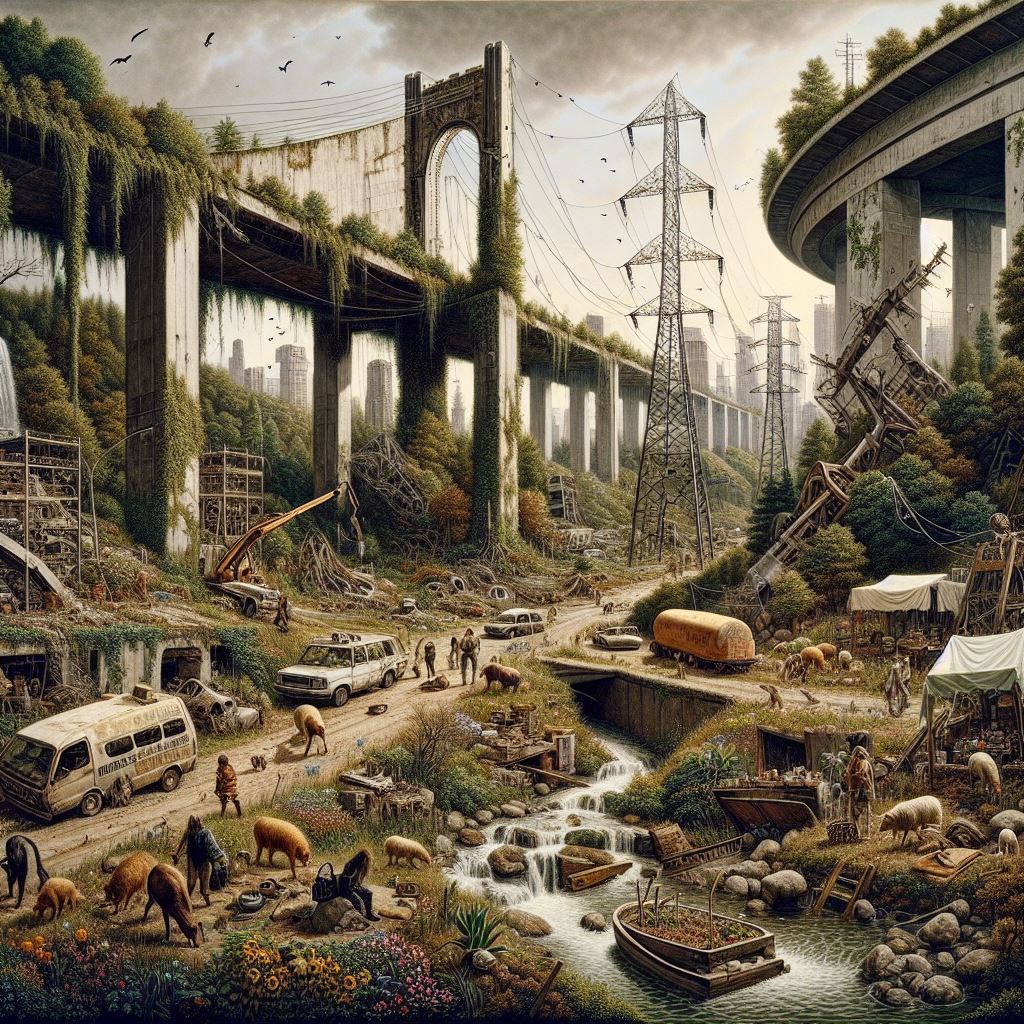
Let’s pause for a moment to savor the irony in this situation. Exceptionalists believe there is no genetic influence human on behaviour, yet engagement in the social construction of ‘reality’ is, itself, an innate characteristic of H. sapiens that helps shape human societies everywhere (albeit in different ways). Moreover, the specific notion of infinite growth reinforces (and may subconsciously spring from) two other survival-oriented heritable traits: the tendencies to expand into any accessible habitat and to use up all available resources.
And it doesn’t end there. H. sapiens evolved in competition with other species – including other extinct ‘hominins’ – for both habitat and food (i.e., biomass energy); natural selection for superior intelligence and social organization obviously gave us a leg-up in the competition for both. Science shows that no other large vertebrate species comes close to modern humans in terms of total population, geographic range or our ecological impacts. We are top carnivore and dominant herbivore, often by several orders of magnitude, in every accessible ecosystem. We are the also major geological force changing the face of the planet. It is impossible to square these objective realities with the pan-cultural delusion that the human enterprise is detached from, and operates independently, of ‘the environment’
Read more: Stands to Reason

