
Highlights
- The stable climate of the Holocene made agriculture and civilization possible. The unstable Pleistocene climate made it impossible before then.
- Human societies after agriculture were characterized by overshoot and collapse. Climate change frequently drove these collapses.
- Business-as-usual estimates indicate that the climate will warm by 3°C-4 °C by 2100 and by as much as 8°–10 °C after that.
- Future climate change will return planet Earth to the unstable climatic conditions of the Pleistocene and agriculture will be impossible.
- Human society will once again be characterized by hunting and gathering.
Abstract
For most of human history, about 300,000 years, we lived as hunter gatherers in sustainable, egalitarian communities of a few dozen people. Human life on Earth, and our place within the planet’s biophysical systems, changed dramatically with the Holocene, a geological epoch that began about 12,000 years ago. An unprecedented combination of climate stability and warm temperatures made possible a greater dependence on wild grains in several parts of the world. Over the next several thousand years, this dependence led to agriculture and large-scale state societies. These societies show a common pattern of expansion and collapse.
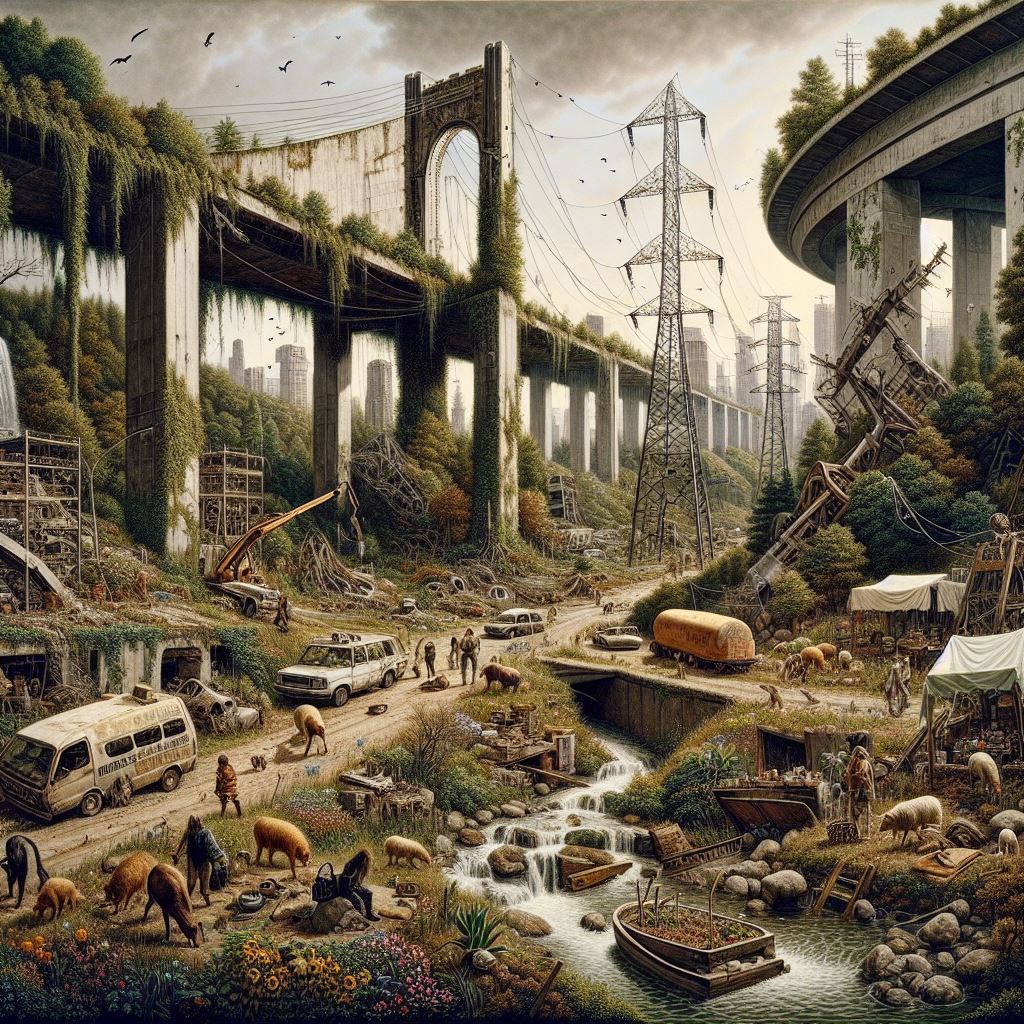
Industrial civilization began a few hundred years ago when fossil fuel propelled the human economy to a new level of size and complexity. This change brought many benefits, but it also gave us the existential crisis of global climate change. Climate models indicate that the Earth could warm by 3°C-4 °C by the year 2100 and eventually by as much as 8 °C or more. This would return the planet to the unstable climate conditions of the Pleistocene when agriculture was impossible. Policies could be enacted to make the transition away from industrial civilization less devastating and improve the prospects of our hunter-gatherer descendants. These include aggressive policies to reduce the long-run extremes of climate change, aggressive population reduction policies, rewilding, and protecting the world’s remaining indigenous cultures.
1. Introduction
Anatomically modern humans, Homo sapiens, have inhabited the earth for more than 300,000 years (Stringer & Galway-Witham, 2017). For at least 97 % of this time our hunter-gatherer ancestors lived as many other large predators do, in small groups within the confines of local ecosystems (Diamond, 1987; Gowdy, 1998; Ponting, 2007). Human populations grew and shrank with changes in climate and food resources flowing directly from the natural world—from the hundreds of plants and animals they depended on. Human life on Earth, and our place within that web of life, changed dramatically during the Holocene, a geological epoch that began about 12,000 years ago. An unprecedented combination of climate stability and warm temperatures made possible a greater dependence on wild grains in several parts of the world. Over the next several thousand years, this growing dependence led to agriculture and large-scale state societies (Gowdy & Krall, 2014). It took only a few thousand years after sedentary agriculture began for it to spread and become dominant in the Middle East, South Asia, China, and Mesoamerica. Within that relatively short time period, agriculture caused the world human population to explode from 4 to 6 million to over 200 million by the beginning of the Common Era (CE) 2000 years ago (Biraben, 2003).
The adoption of agriculture made the average person worse off for millennia. Physical health declined dramatically and most of the world’s people were born into rigid caste systems and lived as virtual or actual slaves. According to Larsen (2006 p. 12): “Although agriculture provided the economic basis for the rise of states and development of civilizations, the change in diet and acquisition of food resulted in a decline in quality of life for most human populations in the last 10,000 years.” After agriculture, humans became shorter and less robust and they suffered from more debilitating diseases, from leprosy to arthritis to tooth decay, than their hunter-gatherer counterparts (Cohen & Crane-Kramer, 2007). It is only in the last 150 years or so that the longevity, health, and well-being of the average person once again reached that of the Upper Pleistocene. The average human life span in 1900 was about 30 years, and for Upper Pleistocene hunter-gatherers it was about 33 years.1 Given the predicted dire economic consequences of climate change and biological annihilation, it is doubtful that these improvements can be maintained. Care must be taken not to see the achievements of the very recent past as representative of the health and well-being consequences of the agricultural revolution.
Agriculture and civilization were possible because of the unusually warm and stable climate of the Holocene. Before then, year-to-year variations in temperature and rainfall made agriculture too undependable to support settled communities with large populations. The Earth’s climate has been unusually stable for about 10,000 years. But with the human-caused increase in CO2 levels we have locked ourselves into a new period of climate instability that scientists predict will be comparable to the conditions of the Pleistocene. During that epoch, climate changes from warm periods to ice ages were triggered by swings in atmospheric CO2 levels of about 50 ppm around the average of 250 ppm. The temperature variations were about 4 °C from the average. In just the past 70 years human activity has increased atmospheric CO2 levels by 100 ppm to over 400 ppm, and the Earth’s average temperature has warmed by 1 °C. Unless draconian measures are taken to halt the increase in atmospheric CO2, global temperature will likely increase by at least 3 °C above today’s by the year 2100 and could eventually increase by 8 °C or more (the so-called mega-greenhouse). Given the large human population, the likely effects of climate change on economic and social stability, and the potential fragility of the world’s industrial agricultural system, it is unlikely that human civilization can survive the coming mega-greenhouse. The prospect of civilization collapse has now entered the mainstream of scientific and popular discourse (BBC, 2019; Diamond, 2019; Spratt & Dunlop, 2019). In the discussion below, the period two to three centuries in the future is used as a general reference point for the ultimate effects of human-caused climate changes. This long-term view avoids the quagmire of the “immediate collapse” versus the “peak and decline” discussions (2012, Randers, 2008) and also gets us close to the likely ultimate business-as-usual peak of temperature and CO2 levels.
Read more: Science Direct

