
Why everything is breaking down and why all at once
The old world is falling apart in front of our eyes. Models, which used to predict what’s coming no longer work—if they ever did. Assumptions about the future are being tested to destruction and are replaced with anxiety and fear of a dystopia we thought could only exist in dark sci-fi novels. Yet, the end of the world as we know it does not mean the end of the world itself: it only marks the beginning of a long, bumpy and undulating road to a new, radically different kind of life. Welcome to the Great Discontinuity.
Model Breakdown
We live in a supermassive complex system, often referred to as modern industrial civilization, or the world economy in short. This monster of an organism has a life of its own with its own inputs (natural resources) and outputs (products and pollution)—just like any living being or physical process in the Universe. Humans are, of course, an integral part of this system: driving the extraction of minerals and consuming the food, plus the gazillion of products and energy, made available in the process.
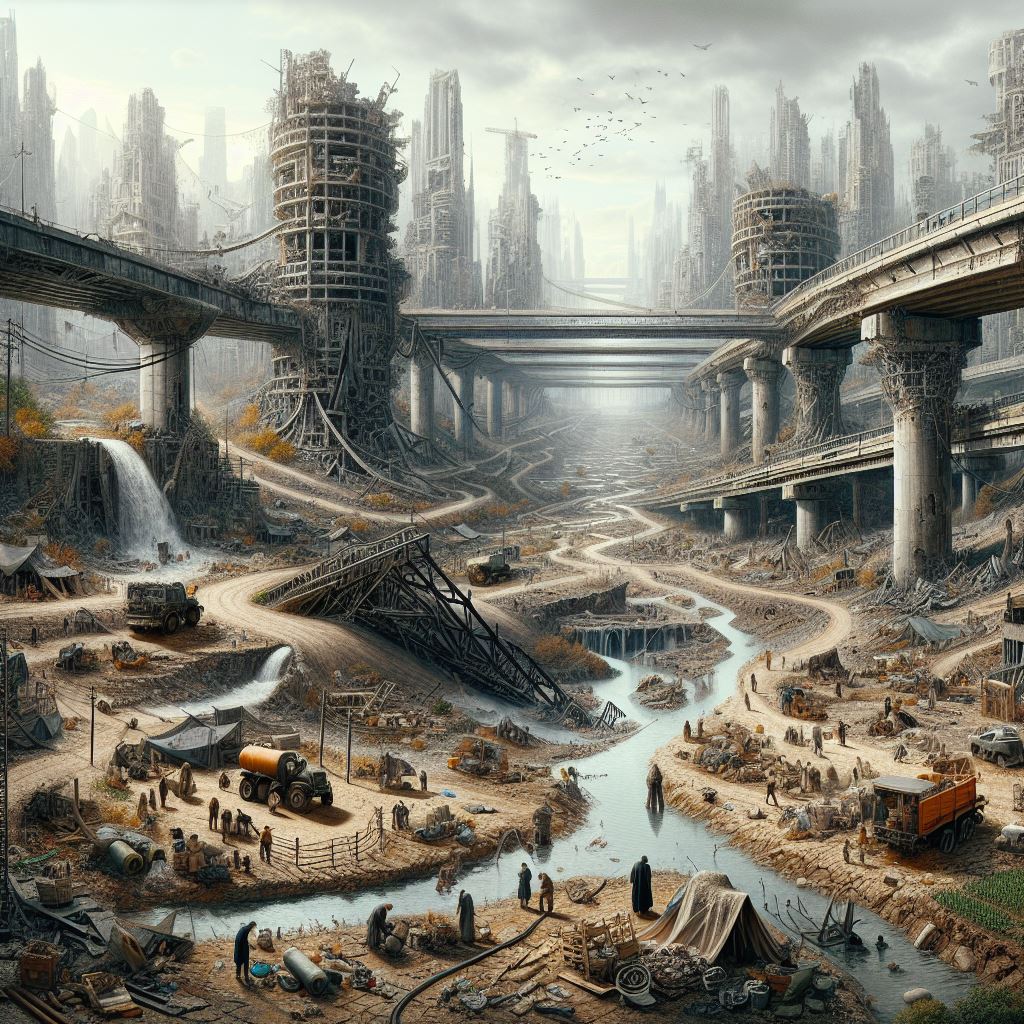
A dystopian scene of societal collapse (Image: Tanjent/Copilot)
And this is where economic models, focusing solely on “utility” and prices—pure figments of human imagination—diverge from reality. This narrow minded world view has produced a number of unrealistic assumptions on which our entire modern civilization was built, and all of which are being tested to destruction as I write these lines. The map, which we confused with the territory for so long, is being ripped asunder as the current world order and the technological hubris it produced crumbles under its own weight. The ideas which we built this civilization on have become rifts and tears in the fabric of the map economists and politicians used to guide us with into a future of more and better. But what comes after when economic and geopolitical models built on these cease to be working?
1. Prices, supply and demand
If something as complex as the world trade of goods and commodities can be described in such simple terms (and using so few variables) as these, you can be sure that something is amiss. And while ‘all models are wrong, but some are useful’—as George E. P. Box once put it—this one has definitely reached the end of its useful life. See, in an ever growing world with ever expanding material and energy availability one could’ve said that ‘if the price is right more supply will surely come online.’ Well, not anymore. We live in a world where the growth of “supply” is not only increasingly restricted by the depletion of rich mineral deposits, aquifers, ecosystems etc. but world powers actively destroying each others assets: oil wells, refineries, transport vessels and shipping routes.
Yet, despite the current upheaval, copper and silver supply was already restricted by geological limits; well before the war on Iran has started. Diesel fuel—powering mining, agriculture, transportation and construction—was already restricted due to limited access to medium heavy conventional crude oil; again, well before hostilities around Hormuz began. What’s worse, according to the IEA, around 80% of global oil and 90% of natural gas production came from fields that had passed their peak (including unconventional fields) in 2024, with the depletion of old fields accelerating over time. There is not much time left—perhaps 4-5 years—till natural decline in oil production takes over any (and all) additions to global oil supply. And no price increase can change that, only accelerate the fall by destroying demand.
Read more: The Honest Sorceror

